My art manager is an AI
Drops are getting rare, so I needed a manager. Mine never sleeps, takes no commission… and it's an AI agent.
Every Monday, I open my terminal and type /point. A few seconds later, I have the list: two replies to send, one follow-up due, an open call closing in nine days. And three priorities for the day, not one more.
A Monday check-in, a draft reply and an opinion, with made-up names.
Behind that command is an AI agent I’ve handed a whole part of my job as an artist. Here’s why, how it works, and above all what I don’t hand over.
Drops aren’t enough anymore
Since I started, I’ve mostly sold my work through drops: on an announced date, I put a series on sale online, and each collector buys one piece of it. The problem is that the NFT market has run out of steam. Drops are getting rarer, and many of them aren’t really worth the time they take anymore.
So I had to find other ways to get paid: commissions (for brands, venues or private collectors), licences so my works can play on screens, talks, exhibitions…
Searching takes forever
I make art alongside Human Coders, a training company for developers that I co-founded in 2012 with Matthieu Segret. Roughly, art gets one or two days a week.
And these new leads mostly take time: finding a conference, spotting an open call before it closes, putting together an application, following up at the right moment… As long as drops were enough, I could do without. With more leads running in parallel, it became very easy to let one slip, just because I forgot to reply.
How does it work?
No app, no database: it’s a plain folder of text files that I open with Claude Code, an AI agent. It reads them, keeps them up to date and tells me what it thinks. A bit like a logbook that talks back.
Inside, there is:
- a memory: my works, my exhibitions, my bio, where each project stands and a log of my decisions;
- a follow-up: for each lead, who has to act, the next step and its date;
- rituals, as skills (commands): the daily check-in, a frank opinion on an offer, a weekly watch of upcoming drops and open calls, weekly and monthly reviews;
- a direction: my goals for the quarter and written criteria for saying yes or no (pay, recognition, reusing an existing work, a new network).

The folder, simplified: a few text files, and that’s all.
It’s also what helps me run this website: adding an exhibition, photos, a new text…
What it changes
Honestly, the most useful part isn’t what I expected. It doesn’t find everything for me, but it helps me a lot not to forget anything, to prepare documents (a portfolio, a presentation PDF…), to find the right arguments and to run several leads at once.
In October 2026: Résilience shown at the Processing Community Days in Tehran and İzmir, an interview published by Rock Badger, my works in Artpoint’s catalogue for screens, several festival applications and two talks to prepare. All at the same time, without dropping anything.
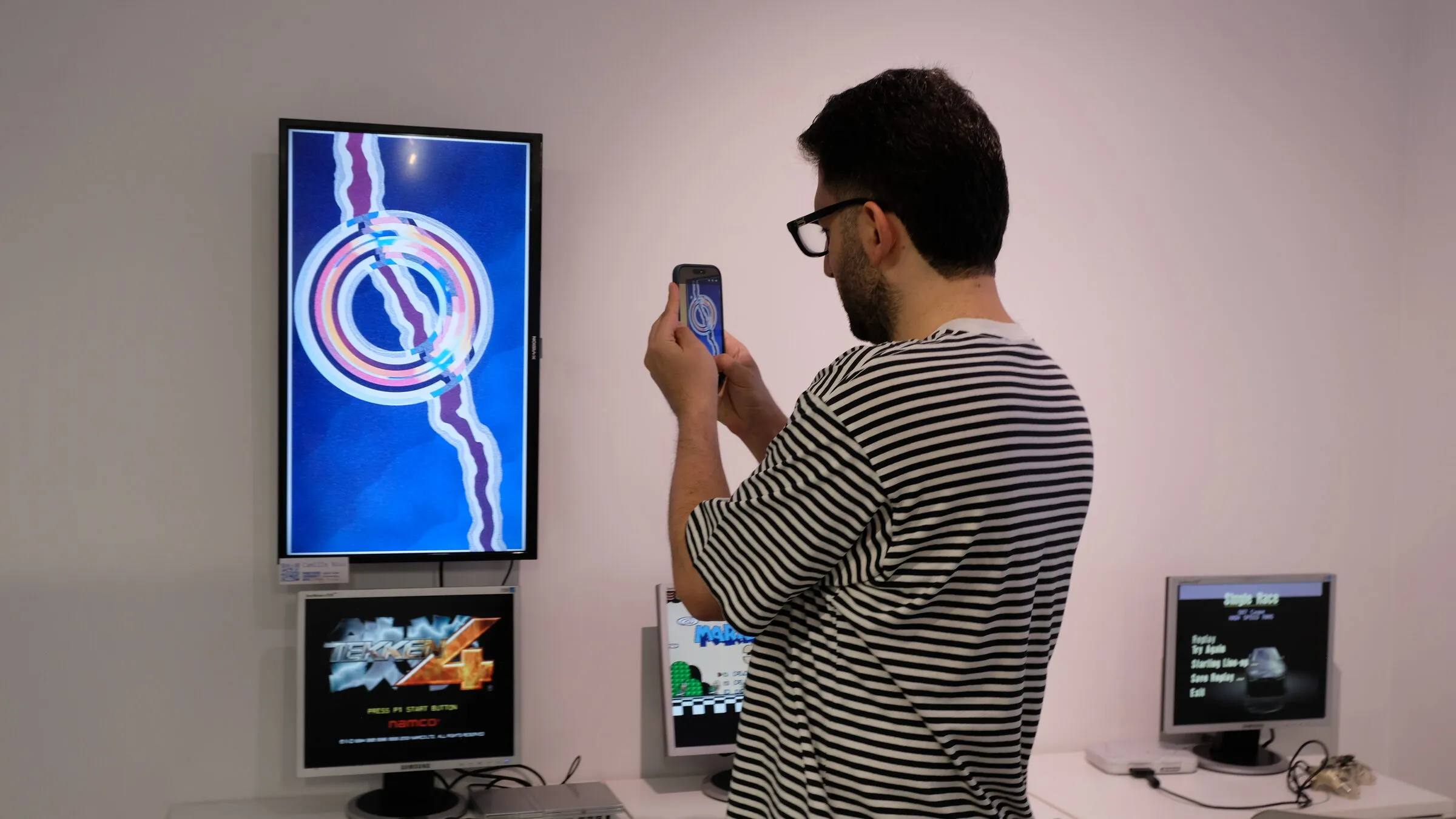
Résilience at Processing Community Day Tehran, Iran Computer Museum, October 2026.
The real eye-opener came when we went through my archives together, five years of posts and old conversations: I found several open doors I had never walked through.
What I don’t hand over
The art. This manager doesn’t touch my works: the ideas, the aesthetics and the choices stay mine. That’s actually the point of all this: freeing up time to create. (I do use AI to help me write the code of some works, which I’ll talk about in an upcoming text.)
Every word that goes out. It writes drafts; I read them, correct them, often rewrite them, and I’m always the one who sends. For a recent application, its first version got the facts right but didn’t sound like me at all. We redid it from what I told it about the work.
The decisions. It gives me its opinion, sometimes very bluntly, but I always make the call. Until I’ve approved an idea, it’s just a recommendation. And when it’s missing information, it asks me rather than making up a number.
The relationships. Video calls, meetings, conversations with other artists: that’s obviously me.
If you want to try
You don’t need to code. With any AI assistant, you can start with three files (who you are, your leads with their next step and its date, your decisions), three habits (check in at the start of each session, write everything down right away, never leave a lead without a date) and one rule: the AI suggests, you decide, and nothing goes out without you reading it.
What’s next?
I already have a few ideas:
- a task manager, to have a single list with my other projects;
- managing my calendar, so it can suggest slots when I’m free on its own;
- social media, to prepare posts that I approve before they go out;
- a watch that runs on its own, with a report waiting for me on Monday.
Always with the same rule: more access, but nothing goes out without me.
What I take from it
This manager doesn’t replace a real agent. It has no network, it doesn’t have lunch with anyone and it has no artistic taste. But it has become a kind of second brain for everything around my works: it remembers everything, it reminds me of everything, and above all, it gives me time back to create.
I’d like to turn it into a tool other artists could install too, for example a plugin, like my genart skill. If you’d be interested, let me know on X or Bluesky!
Read also


Newsletter
The next texts, by email.
Day to day
Work in progress and shorter notes.
Keep going:the seriesother textscommissions