Algorithmic Art: When AI Writes the Code, Where Is the Art?
Generative art, algorithmic art and AI: when an AI can write the code, where does that leave the artist? The limits, the new role, and what this shift redefines.
About two years ago, I wanted to code a GPGPU system of a million particles with Three.js. I barely knew Three.js, the technique is a real pain, and I expected to spend several weekends on it.
I asked Cursor for help. AI coding tools were far weaker than they are today, and yet it saved me an enormous amount of time.

One of the first studies, December 2024 · 100,000 particles on the GPU, Three.js, a million in later versions · the post
At the time, I was mostly pleased. Only later did I understand what it meant for the field I make my work in.
Until then, in generative art, we had watched the AI wave from a distance. AI could generate images, not code, at least not real code, not a three-thousand-line shader.
And our code is public: it is written on the blockchain and runs in the browser of whoever buys the work. We felt doubly protected, by difficulty and by transparency.
That wall had just fallen, and I had benefited without realising it.
A word on vocabulary: I’ll say algorithmic art here rather than generative art. Since the 1960s, with Vera Molnár among others, “generative art” has meant works produced by an algorithm, rules and a share of chance, but today the word mostly suggests Midjourney, which is the opposite.
(If you are new to this, I wrote elsewhere about how to make art with code.)
My intention is not in the image
When I release a long-form series, I don’t see the works before you do. I write an algorithm, I publish it, and each person’s transaction decides the work they receive.
However many thousands of outputs I test while developing, some combinations only appear at mint, and a piece often surprises me too.
So no, my intention is not in the final image. It is in the space of possibilities that image comes from.
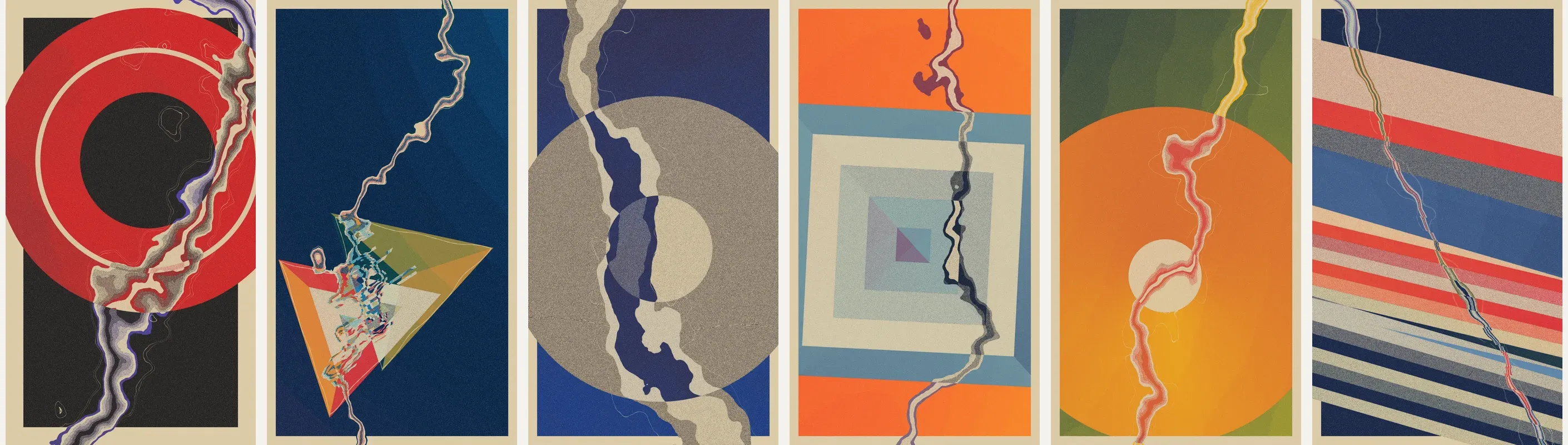
Résilience #1, #7, #10, #12, #14 and #20: one algorithm, six works.
Matt DesLauriers puts it better than I do:
They are basically coordinates into a very high-dimensional parameter space where a lot of this code exists.
He adds that in long form, the work is about taming chaos, while keeping enough surprises that the collection doesn’t collapse into a single work.
When I make a series, there are times when I look for ideas, times when I code, and times when I tune my algorithm. But I never draw one image in particular: all that work goes into setting the bounds of the space, and deciding what is allowed out of it.
You could reply: if I don’t choose the final image, how is that different from someone writing a prompt?
For me, the difference isn’t the tool. It is who built the space of possibilities.
When you write a prompt in Midjourney, that space was built by others: by the people who trained the model, with images you didn’t choose. You can make real choices in it, but you stay in their space.
When I write my algorithm, I build the space: the rules, the shapes, the colours, the share of chance. And it can produce shapes that exist nowhere else.
A song that moves you
Patrick Baud asked PV Nova this question on his French podcast Continue tu m’intéresses, and it has stayed with me.
Imagine. You’re listening to a playlist, a song comes on and it really moves you. You don’t know who it’s by. You look it up, and find out it was generated by an AI.
How do you feel?
Honestly, I wouldn’t feel deceived, since nobody lied to me. But my emotion would fade. I want what I feel to come from someone.
PV Nova puts it well:
Une grande partie de l’intérêt et de la force d’une œuvre pour moi, c’est le fait qu’elle provient d’une sensibilité, d’une intention, d’une expérience.
For him, much of the interest and power of a work comes from the fact that it stems from a sensibility, an intention, an experience.
It’s like a handmade gift: the same object, bought or made, doesn’t have the same value. A work isn’t only worth what we perceive, but also the bond with the person who made it. We want to know there is someone behind it.
That’s why intention matters more than the mere ability to move us.
When AI makes art
I’m setting aside the very real problems of generative AI (copyright, energy, bias), which would deserve their own article. My question is elsewhere: if those problems were solved, could images made with AI be works of art?
For me, yes, and I’ve seen some. At Bright Moments Paris, for instance, I discovered the work of Linda Dounia. She doesn’t use the big models: she trains her own, on images she gathers herself (her own paintings, endangered Sahel flowers tracked down as far as the archives). She explains why:
I can gather data on my own, about things I care about, in places that are unimportant to the zeitgeist.
Her work moved me, and I see no reason to deny it the status of art. To come back to the criterion: she built the space. AI is one tool among others there, in the service of an intention.
And me?
My works aren’t images generated by an AI: my algorithms produce my series. But to write the code of those algorithms, I get more and more help from AI.
If you don’t code, know that this has become common practice: getting help from a tool like Claude Code or Cursor is now part of developers’ daily work. In Stack Overflow’s 2026 survey, only 17% say they don’t use AI tools, and two thirds use a coding assistant or agent.
My rule is the same as for any software project: stay in control of your code and own it, the way you own a pull request you merge.
In practice, AI saves me days on tooling, optimisation, maths, rendering, and more and more on the code of the work itself. Art direction, on the other hand, is mine, and it’s what I enjoy most in this work. And even on the technical side, I still often have to take back control.
But sometimes it works right away. For Confluence, a series in progress, I wanted to try the physarum algorithm, which mimics the way a slime mould spreads its network to find food. Claude implemented it in one shot, and it was great.
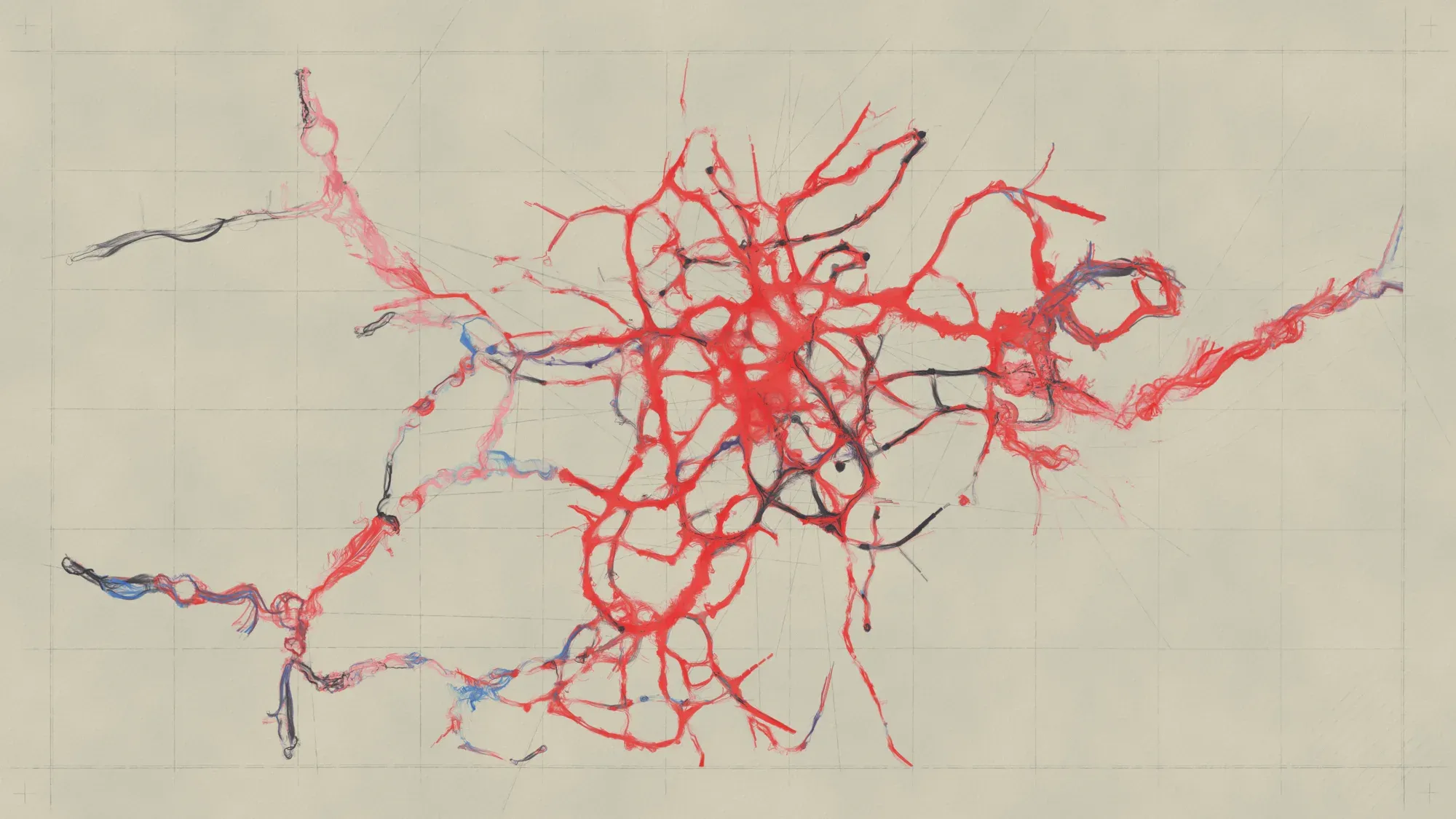
Confluence, study with physarum, October 2026.
AI writes more and more of the code. The decisions remain mine, and that is where the work lies.
Even when AI writes the code, I’m the one who defines the space: the rules, the bounds, what is allowed out of it.
This debate isn’t new. A few years ago, people wondered whether you had to code a Voronoi diagram yourself to be a “real” algorithmic artist, or whether you could use a ready-made library. The field’s answer: why reinvent the wheel?
The AI question extends that debate, without being quite the same. A library does what you ask. An agent fills in the gaps. If I ask it to add noise to some lines, it will pick the kind of noise, its scale, its strength on its own. Nothing wrong, but those small choices are often what give a work its character.
So most of the time, I describe as precisely as I can what I expect: the look, the movement, what I really don’t want. But sometimes I leave it gaps on purpose. Like the chance in my algorithms, it can surprise me, sometimes pleasantly. A good surprise, I keep, but I’m the one who decides to keep it.
The feat now comes at a price
There are a thousand ways to appreciate a work of algorithmic art: its aesthetics, what it says, the emotion it stirs… Technique is just one axis among others. But in front of a piece, we often wonder: was it hard to make?
AI moves that bar. What took weeks of work three years ago is now within reach of far more people. To impress, you have to go further.
Except that cost hasn’t disappeared, it has changed form: it is now paid in tokens.
You never needed an expensive guitar to be a good guitarist. But I fear a race to complexity, where the most spectacular pieces will come from those who can pay for the best models, or the machines to run them.
That is precisely what this field had managed to avoid. With code running in a browser, people all over the world could live from their art without going through the usual channels. Not everyone had the same chances, but the tool itself was free: a text editor and patience.
And what can be rebuilt easily can also be copied. In October, the artist Mannay found a work in progress, shared for over a year, rebuilt as a demo with AI, without so much as a message to ask:
this is exactly why i’m getting reluctant sharing gen art WIPs now. context: 1+ year working on this sharing, testing, iterating, building the whole system, then you wake up to a vibe-coded a clone, no DM/ask/nothing. The "spending a year to build something takes far too long…
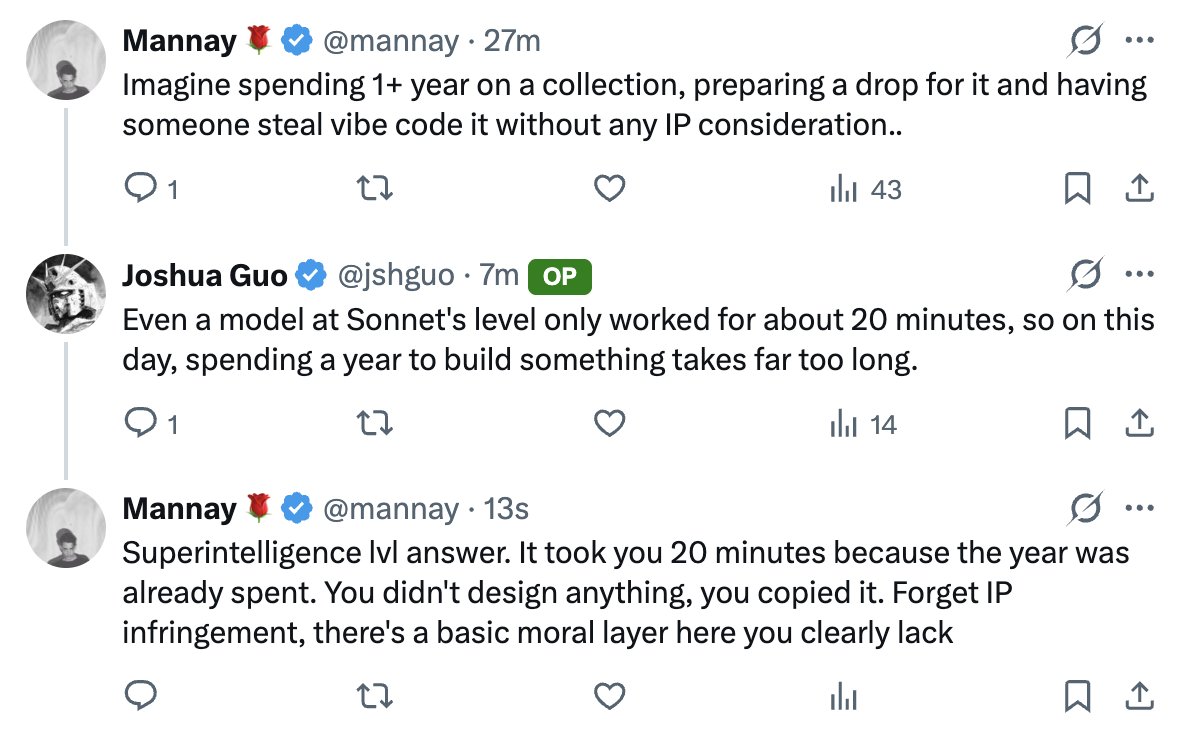
Further down the post:
if anyone can rebuild anything in 20m then the only thing left that’s worth anything is the vision. and that’s exactly what’s being taken.
He makes it clear, though: “i’m pro AI”. What he objects to is taking unreleased work and publishing the copy first. Since then, he shares fewer works in progress.
A “no AI” movement?
One could imagine a “no AI” movement emerging, a bit like punk in its day: claiming the handmade, the human, with no compromise. I like the idea. Some artists already work without AI, or very little: it’s a demanding choice, and I fully respect it. I’m not trying to convince anyone to work like me, only to explain how I do it and why.
But a movement soon runs into two problems.
First, where do you draw the line? There is a world between:
- an entirely generated image;
- an algorithm written by an AI;
- a few lines completed in passing;
- a simple conversation to explore an idea.
No label tells them apart.
Then, how do you prove it? Neither an image nor a code history says who wrote what.
So maybe that’s not the right question. I get the feeling that most artists and collectors have already accepted it: as in software, almost all upcoming projects, and probably many released in recent months, have been or will be made with the help of AI.
What really bothers people is something else: a project obtained by simply asking an AI to “make me a generative artwork”, and released as is, without anyone making real choices. That’s the line that comes up most often in discussions between artists, and the only one that seems to me to hold. The problem isn’t the tool, it’s the absence of decisions.
The real risk isn’t authorship, it’s monoculture
A text by Monokai on language models, A Most Comfortable Dead End, changed the way I see the subject:
What kills a monoculture is not sameness. It is shared origin.
He illustrates it with a field:
A field can hold a hundred varieties and still die as one field if every seed came from the same supplier
Applied to algorithmic art: if everyone creates with the same few models, we can get thousands of different works that all share the same blind spots, and the same small choices slipped into the code. What those models never suggest will end up not being explored at all.
So the real risk isn’t who wrote the code, but watching the space of possibilities close.
Keeping control
The particle system from the beginning: Cursor helped me code it. But why I made it, what I wanted to put into it, its colours, its movement, the moment I decided it was finished: no AI chose that for me.
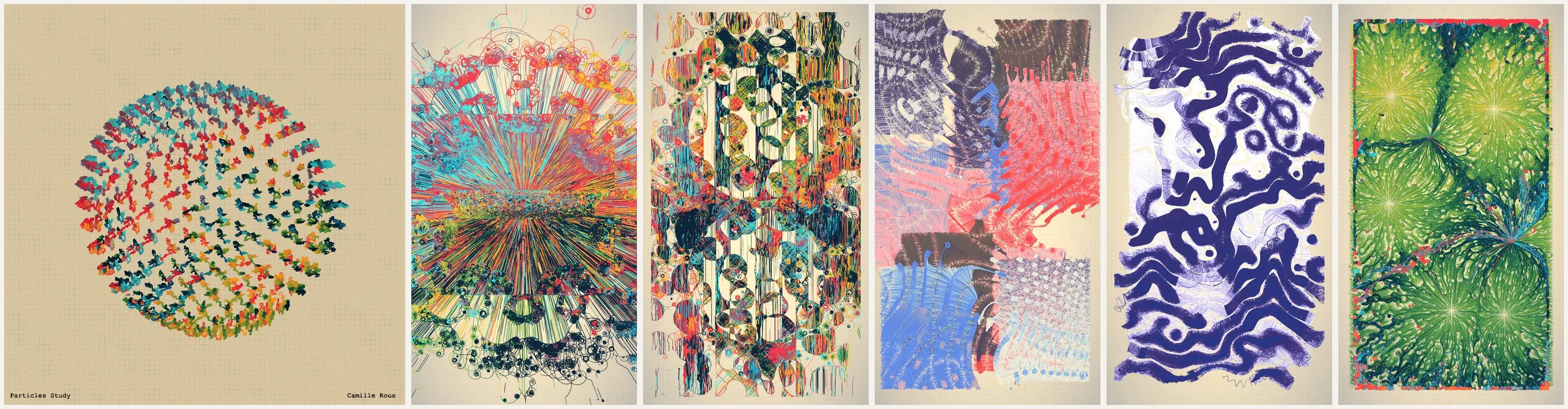
Studies from the same particle system, September to December 2024. The last one opens this article.
Ahmad Moussa, aka Gorilla Sun, reaches the same place in Creative Coding in the Age of AI:
the realistic way forward is using these tools in a way that doesn’t completely remove us from the loop.
The technical wall has fallen, and it won’t be rebuilt. So when AI writes the code, where is the art? In what no tool provides: a reason to make the work, and the space of possibilities you build for it.
It is also the best answer I know to copying and to monoculture. A demo can take a look, not the reasons it came from. And the more personal a work is, the more it widens the space instead of closing it.
So I’ll keep putting as much of myself as possible into my work. AI will probably help me more and more, but it will never do it for me.
Read also


Newsletter
The next texts, by email.
Day to day
Work in progress and shorter notes.
Keep going:the seriesother textscommissions