What Is Generative Art? Definition, Examples and the Difference with AI
Generative art explained simply: artworks produced by an algorithm, rules and a share of chance. Examples, its history, and how it differs from AI.
There are many definitions of generative art. Here is a simple one:
Generative art is an art practice, usually digital, that uses algorithms to make works that generate themselves, or that are not decided in advance.

ARTERIA #5, #38, #170, #236 and #302: five pieces from the same script · Camille Roux
Since the 1960s, with Vera Molnár among others, the word has meant works produced by an algorithm, rules and a share of chance. Today, though, it mostly brings to mind images generated by AI, which is the opposite. That’s why, in my texts, I tend to say “algorithmic art”: the same practice, with a word that is less confusing.
Creative coding is a broader term. It means using computer programming as a means of artistic expression in its own right: visual, musical, literary, interactive, performative…
One algorithm, many works
When I make a series, there are times when I look for ideas, times when I code, and times when I tune my algorithm. But I never draw one image in particular: all that work sets the limits of a space of possibilities, and decides what is allowed to come out of it.
In practice, the program starts from a number drawn at random. With another number, the same program gives another work.
Two examples: Résilience and ARTERIA
Résilience starts from a personal idea: each piece stands for a slice of life, marked by events. The events come in different shapes and sizes, like the hardships that shake each of us in their own way. The lines are isolines, like the contour lines of a map: bent by the events, they slowly find their balance again. Each piece has its own palette, and it keeps evolving slowly for as long as it runs.
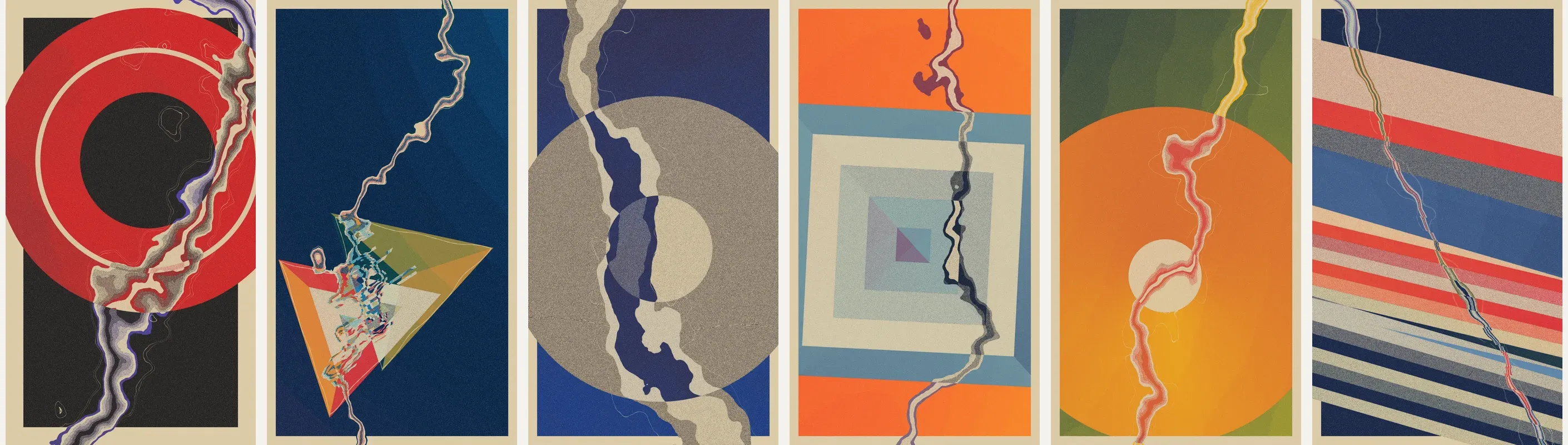
Résilience #1, #7, #10, #12, #14 and #20: one algorithm, six works · Camille Roux
ARTERIA explores autonomous agents: entities that follow a set of simple rules, here to draw paths.
In ARTERIA, the agents have a default behaviour: they go straight ahead, reproduce, and die when they meet the path of another agent. As they move, they draw small circles.
ARTERIA #166 drawing itself: four agents at first, then their offspring · Camille Roux
The final result comes from the initial parameters, the interactions between the agents and the local rules. It shows the beauty and complexity that can emerge from simple rules and autonomous interactions.
Other definitions of generative art
Other definitions go further than this one. Philip Galanter’s, from 2003, is often quoted, by Le Random among others, an institution devoted to generative art:
Generative art refers to any art practice where the artist uses a system, such as a set of natural language rules, a computer program, a machine, or other procedural invention, which is set into motion with some degree of autonomy contributing to or resulting in a completed work of art.
In other words: the artist invents a system (written rules, a program, a machine) and leaves it some autonomy. Le Random sums it up in four words: “art using autonomous systems”.
Before the computer: Vera Molnár’s “imaginary machine”
With this definition, there is no need for a computer. Sol LeWitt, who wrote instructions for others to paint his walls, is one example.
Vera Molnár is another. From 1959, as the Centre Pompidou tells it, she worked with her “imaginary machine”: a simple program of instructions and prohibitions that transforms shapes. She then drew by hand the proposals she kept.
In 1968, she finally got access to real computers, at the computing centre in Orsay:
Vous ne pouvez pas imaginer quelle a été l’émotion de voir apparaître pour la première fois sur l’écran ce qui existe naturellement dans votre cerveau !
You cannot imagine, she says, the emotion of seeing appear on the screen, for the first time, what exists naturally in your brain.
She added what the Centre Pompidou calls her “1% of disorder”, which she put into her works to shuffle the cards and unsettle the system. Rules, and a share of chance.
The rest of this French story, from Vera Molnár to today, is in Generative Art in France: Some Forty Artists to Know.
Generative art and NFTs: long form
Most of my series were released as long form. Tyler Hobbs gave the format its name, in 2021. Here is how he describes it:
The artist creates a generative script (e.g. Fidenza) that is written to the Ethereum blockchain, making it permanent, immutable, and verifiable. Next, the artist specifies how many iterations will be available to be minted by the script. […] Nobody, including the collector, the platform, or the artist, knows precisely what will be generated when the script is run, so the full range of outputs is a surprise to everyone.
Each collector gets a unique piece, decided by a random number, usually the hash of the transaction on the blockchain.
For the artist, this changes everything. Tyler Hobbs again:
With long-form works, the artist has nowhere to hide, and collectors will get to know the scope of the algorithm almost as well as the artist.
There is no showing only the best outputs.
I may test thousands of outputs while I develop, but some combinations only appear at the time of the sale, and a piece often surprises me too.
Where is the work?
Peter Bauman asks the question at Le Random:
Because generative art requires an autonomous system to produce output, questions naturally arise as to where the artistic intent lies: the system or the potentially infinite variations it can generate?
When I release a long-form series, I don’t see the works before you do. I write an algorithm, I publish it, and each person’s transaction decides the work they receive.
So my intent is not about the final image. It is about the space of possibilities that image comes from.
Generative art and generative AI: the confusion
One could answer: if I don’t choose the final image, what’s the difference with someone who writes a prompt?
For me, the difference is not the tool. It’s who built the space of possibilities.
When you write a prompt in an image generator, that space was built by others: by the people who trained the model, with images you didn’t choose. You can make real choices in it, but you stay in their space.
When I write my algorithm, I build the space: the rules, the shapes, the colours, the share of chance. And it can produce shapes that exist nowhere else.
I go further in Algorithmic Art: When AI Writes the Code, Where Is the Art?
Where to start making generative art?
Start with p5.js, a JavaScript library, probably the most widely used, especially by beginners. Think of Paint, but in JavaScript: to draw a circle, just call the circle() method with a position and a size.

One of my very first sketches in p5.js · Camille Roux
A few resources to go further:
- The Coding Train: a monumental YouTube channel covering p5.js and many algorithms;
- Bootloader: the platform I would recommend today for a first project, open to everyone;
- awesome-generative-art: my list of resources to create, learn and publish;
- GENART: the voice-message channel of generative art, where artists answer a question with a voice note.
Everything is explained in Coding for Artists: A JavaScript and p5.js Tutorial to Start.
And I tell my own path, from my first sketches to a release with gm.studio, in Algorithmic Art: From Discovery to a Drop with a Leading Studio, then on video (in French), closing DevFest Toulouse 2023:
Generative art: from discovery to a release with a studio, DevFest Toulouse 2023 (in French)
And to have an algorithmic work at home: my series, signed prints from €400, or a commissioned work.
Read also


Newsletter
The next texts, by email.
Day to day
Work in progress and shorter notes.
Keep going:the seriesother textscommissions